
PCA PERFORMANCE LAB
Ad Creative Testing: How to Test Different Reasons to Buy
Your team has produced ten advertisements. Before calling that ten ideas, ask how many different customer questions those advertisements answer.
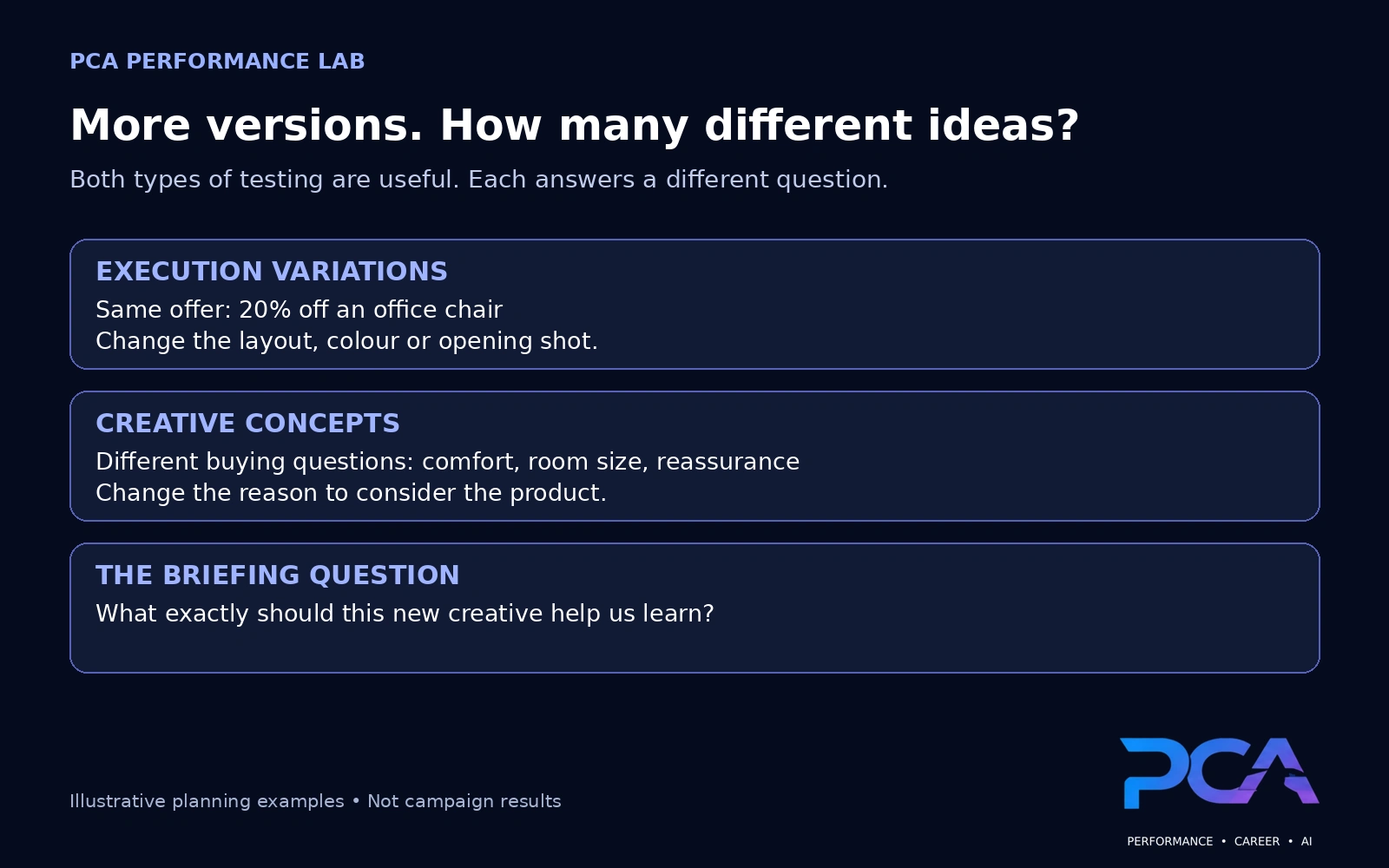
Five designs announcing the same discount can teach you which execution works better. An advertisement demonstrating product fit explores another question: does answering this concern help someone decide? Both are useful, provided the team knows what it is trying to learn.
Why this matters as creative production gets faster
Google’s 1 October 2026 creative guidance recommends starting with suitable existing social assets, making changes gradually and prioritising quality over quantity. Meta’s 6 October announcement describes a wider rollout of Ads Creative Studio and tools to develop and edit creative assets. Availability depends on the feature and account.
Those tools can expand what a team produces. PCA’s interpretation is that a clearer brief becomes more valuable when producing another version becomes easier. Neither announcement establishes that adding more concepts automatically improves results.
What is a creative concept, and what is a variation?
In this guide, a concept means the main selling idea or customer question an advertisement addresses. A variation changes how an idea is expressed: the opening line, visual treatment, format, demonstration or call to action. Teams use these terms differently, so agree your definitions before briefing production.
| Example | What changes? | What might we learn? |
|---|---|---|
| Three designs saying “20% off” | Execution of the same offer | Which presentation attracts a better response |
| A demonstration of chair dimensions | Main buying question | Whether explaining fit helps purchase decisions |
| Two openings for the same dimensions demonstration | Execution within a concept | Which introduction communicates the idea better |
A fictional office-chair example
Imagine a business advertising an office chair. Its current advertisement shows the product and a 20% discount. The team requests five new versions using different colours and photographs.
That is a reasonable execution test. But customers may also be asking: “Will it fit under my desk?”, “What adjustments does it offer?” or “What happens if there is a problem after delivery?”
Each question suggests a possible concept:
- Fit: show verified dimensions and the space needed to use the chair.
- Adjustability: demonstrate the adjustments the actual product supports.
- Purchase confidence: explain the actual warranty or returns terms clearly.
These are hypotheses. A marketer should not invent benefits, make unsupported comfort or health claims, or promise returns that the business cannot provide.
Start with customer conversations
Ask sales and support teams what people enquire about, compare and hesitate over. Review relevant search terms, product questions and reviews. Distinguish repeated concerns from one unusual comment.
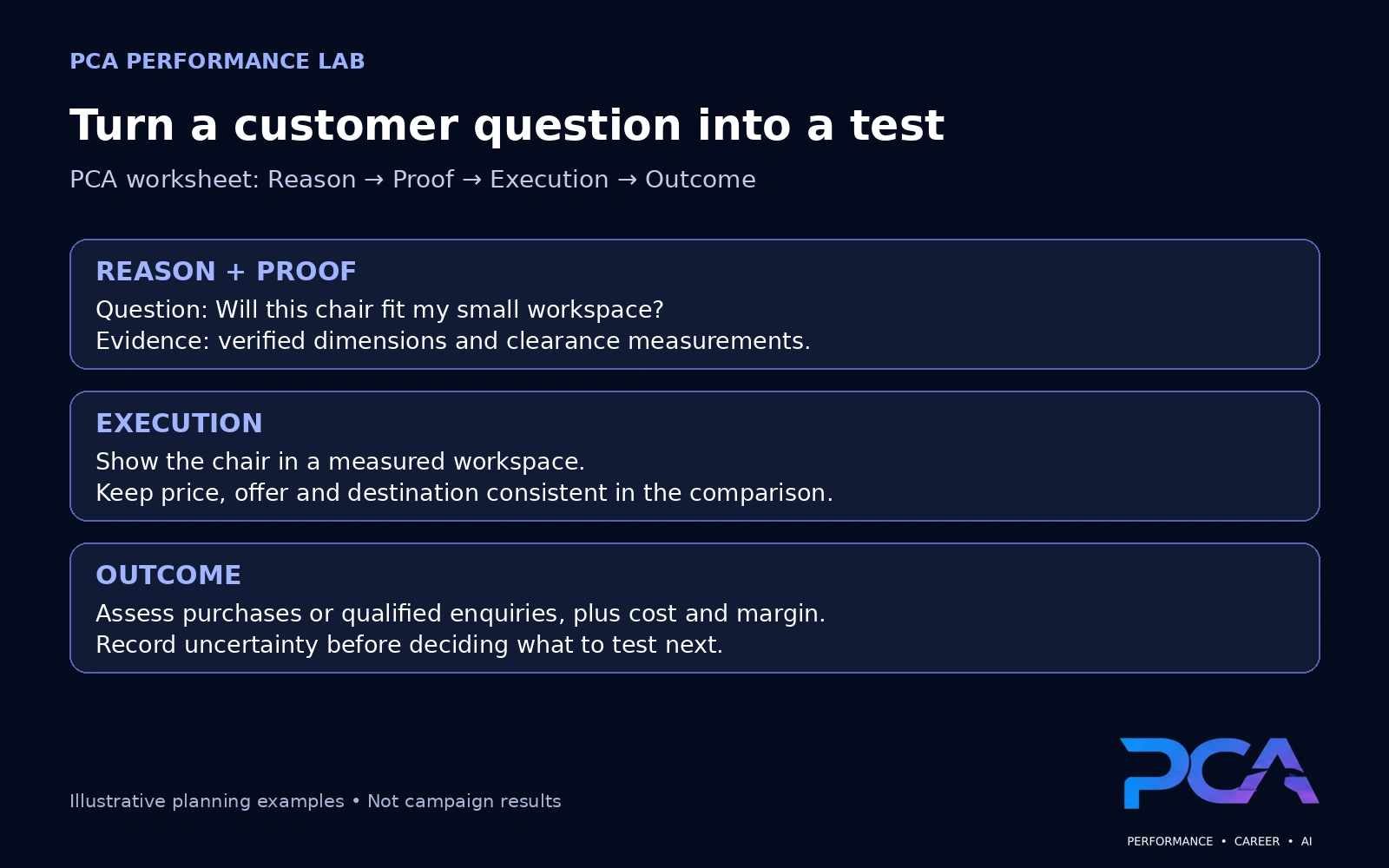
Translate the observation into a testable sentence: “We think customers hesitate because they cannot judge the size. Showing dimensions may help suitable buyers decide.” This is more useful than “make it more engaging” because the team can explain what evidence and execution the brief needs.
The PCA creative testing worksheet
This planning framework is PCA’s own: Reason → Proof → Execution → Outcome. It is not a Google or Meta feature.
- Reason: Which buying motivation or objection are we addressing?
- Proof: What accurate evidence can the business provide?
- Execution: How will we make that evidence understandable in this placement?
- Outcome: What result would justify developing the concept further?
How to make the comparison useful
Decide whether the test compares complete concepts or isolates one execution choice. A concept comparison may intentionally change several creative elements together. It can help identify a promising complete approach, but cannot tell you which individual element caused the difference.
Where practical, keep the offer, destination, audience eligibility and evaluation period comparable. Use the platform’s appropriate experiment tools when available and suitable. Ads placed together in an ordinary optimised ad set do not necessarily receive equal or randomly assigned exposure.
A discounted payday campaign compared with a full-price campaign the following week mixes creative, timing and offer effects. Record those differences rather than giving the creative all the credit.
Choose the primary outcome and review criteria before launch. Budget, conversion delay and available volume determine how much evidence you can gather. There is no universal number of days or purchases that makes every test conclusive. With limited data, mark findings as directional and avoid declaring a winner from one or two sales.
Which results should you review?
Attention and clicks can reveal how an advertisement is received. They do not alone show that the message attracts suitable customers. For ecommerce, inspect purchases, acquisition costs, returns and margin where available. For lead generation, inspect qualified enquiries and later sales, allowing for the sales cycle.
If one creative gets more clicks but fewer qualified enquiries, investigate the promise it makes and the people it attracts. If another gets fewer clicks but more valuable customers, the click-through rate alone would miss that distinction. Neither result automatically establishes incremental impact; that requires a suitable causal measurement design.
Checklist for marketers
- Label each asset with its concept and execution version.
- Write the hypothesis before production.
- Confirm the evidence behind each product claim.
- Adapt framing, captions and demonstrations to the placement.
- Record what changed, how delivery occurred and which outcome matters.
- Document learning and uncertainty before commissioning the next batch.
Checklist for business owners
- Share recurring customer questions and objections.
- Supply accurate specifications, demonstrations and service terms.
- Agree the offer, margin constraints and definition of a valuable customer.
- Give the team enough information to explain value beyond the discount.
- Ask what the last test taught you before requesting more creatives.
What should you do first?
Review your latest ten advertisements. Group them by the main question they answer. Then choose one important customer question your current advertising leaves unanswered. Build one credible concept around it and define what you need to learn.
A useful creative programme produces both assets and knowledge. Execution variations refine communication; concept tests explore which messages deserve further investment.
Build a clearer creative testing plan
PCA Engine helps marketers and business owners connect customer understanding, creative briefs and campaign decisions. Discuss a scoped creative-strategy consultation or a practical workshop for your team.
Book a conversationDiscuss on WhatsAppSources and scope
- Google: Turn your existing social assets into high-impact YouTube ads — 1 October 2026
- Meta: Advertising Week creative tools announcement — 6 October 2026 (Spanish)
Reviewed 28 October 2026. Product examples and the worksheet are explanatory illustrations, not client results, platform features or performance guarantees.