
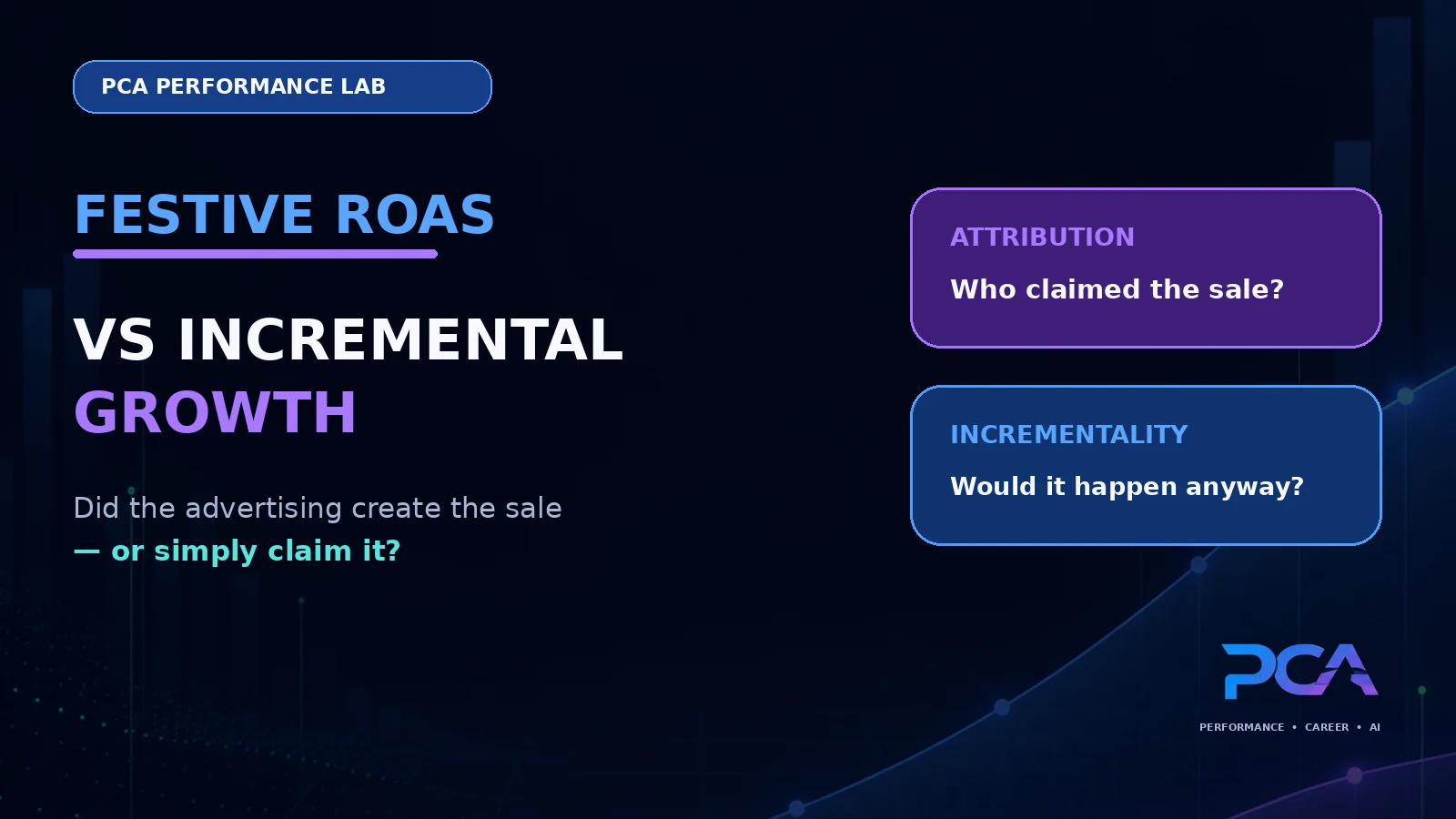
A higher festive return on ad spend can look like proof that advertising worked.
But it may leave one commercially important question unanswered:
Did the advertising create additional sales—or receive credit for purchases that would have happened anyway?
That is the distinction between attribution and incrementality.
Attribution determines which campaign, channel or interaction receives credit for a conversion. Incrementality estimates how many conversions occurred because of the advertising and would not have occurred without it.
The distinction matters throughout the year. During India’s festive season, it becomes particularly important because consumer intent, marketplace promotions, branded searches, repeat purchases and discount-led demand may all rise together.
This does not make platform ROAS useless. It means ROAS must be interpreted alongside the business conditions in which it was generated.
Why festive demand can make every dashboard look healthier
During the first 11 days of India’s 2025 festive ecommerce sales, gross merchandise value reached approximately ₹60,000–62,000 crore—nearly 3.5 times business-as-usual levels, according to Redseer. Around 90 million shoppers participated during that period.
Redseer’s festive ecommerce analysis demonstrates the size of the underlying market movement. When overall demand rises this sharply, advertising platforms are operating in an environment where more people may already be preparing to purchase.
A campaign can therefore report more conversions for several reasons:
- Advertising genuinely created additional demand.
- Existing demand became easier to convert.
- Returning customers responded to a reminder.
- Branded searches increased because of offline, marketplace, creator or CRM activity.
- A discount improved conversion rates independently of the media.
- Multiple platforms claimed credit for overlapping customer journeys.
In practice, several of these effects may occur together.
The measurement challenge is not to dismiss attributed conversions. It is to identify how much of the observed performance represents additional business impact.
Attribution and incrementality answer different questions
Consider a brand that spends ₹1 lakh on advertising and receives ₹6 lakh in platform-attributed revenue.
Its reported ROAS is:
₹6 lakh ÷ ₹1 lakh = 6× ROAS
The dashboard appears strong.
Now assume a well-designed experiment estimates that ₹4 lakh of those purchases would have occurred even without the advertising. The incremental revenue created by the intervention is therefore ₹2 lakh.
Its incremental ROAS is:
₹2 lakh incremental revenue ÷ ₹1 lakh incremental spend = 2× iROAS
The platform did not necessarily report the result incorrectly. Attribution and incrementality were measuring different things:
| Measurement | Question answered |
|---|---|
| Attributed revenue | Which advertising interaction received credit? |
| Attributed ROAS | How much credited revenue was associated with the media spend? |
| Incremental revenue | How much additional revenue did the intervention cause? |
| Incremental ROAS | How much additional revenue was generated per additional unit of spend? |
A campaign can have a high attributed ROAS and a lower incremental ROAS. The reverse can also occur when platform attribution undercounts conversions influenced by media.
How incrementality testing works
Incrementality requires a credible estimate of the counterfactual: what would have happened without the advertising intervention.
The strongest practical approaches create or model a comparison between:
- A treatment group exposed or eligible to be exposed to the advertising; and
- A control group that does not receive the same intervention.
If the treatment group generates significantly more conversions than the control group after accounting for normal variation, the difference can be treated as estimated incremental lift.
Common incrementality methods include:
User-based Conversion Lift
Eligible users are divided into treatment and control groups. One group can receive the campaign, while the holdout group is prevented from receiving it. The difference in downstream conversions provides an estimate of causal lift.
Google Conversion Lift uses this treatment-and-control principle to measure conversions directly driven by Google Ads campaigns. Meta Conversion Lift similarly uses randomized holdouts to estimate the incremental effect of Meta advertising.
Geographic experiments
Comparable locations are assigned to treatment and control conditions. Advertising may be increased, reduced or withheld in selected markets while other markets continue under business-as-usual conditions.
Google’s Meridian GeoX is a global, open-source and publisher-agnostic framework for geographic incrementality experiments. It supports designs including holdback, go-dark, heavy-up and multi-cell tests.
GeoX does not treat attributed ROAS as its outcome. Google recommends using raw, unfiltered revenue or conversion totals so that pre-existing attribution logic does not distort causal estimation. Its documentation also calls for at least three times the planned experiment duration in historical geo-level data, with longer history recommended for strongly seasonal businesses.
Marketing mix modelling
Marketing mix models estimate the relationship between marketing inputs and business outcomes over time while accounting for factors such as seasonality and other demand drivers.
MMM can help with channel-level budget decisions, particularly for businesses operating across online and offline media. However, it usually requires sufficient history, spend variation and reliable business data. It is rarely the first incrementality solution for a brand that began advertising only a few weeks ago.
Is Meta’s Incremental Attribution the same as a lift experiment?
No.
Meta’s Incremental Attribution is a machine-learning attribution model that predicts which conversions were likely caused by an ad. Where available, it can support reporting and campaign optimization based on estimated incremental conversions.
That makes it more incrementality-oriented than a conventional click- or view-attribution window. But it remains a modelled estimate. It should not be described as equivalent to a randomized Conversion Lift experiment.
A useful reporting hierarchy is:
- Standard attributed conversions
- Modelled incremental conversions
- Experimentally validated incremental lift
Each level can inform decisions, but it carries a different degree of causal confidence.
Does Google Ads have an incremental-attribution filter?
Google Ads does not currently offer a universally available standard-reporting filter that is directly equivalent to Meta’s Incremental Attribution view.
Google’s data-driven attribution distributes conversion credit across eligible Google Ads interactions. This can improve credit allocation within the observed journey, but it does not by itself establish what would have happened without Google advertising.
Google’s dedicated incrementality option is Conversion Lift, using user-based or geography-based treatment and control groups for eligible accounts and campaigns.
Similarly, a normal campaign experiment comparing two bid strategies, creatives or campaign versions answers which version performed better. Unless it includes a genuine unexposed control, it does not answer whether advertising was incremental compared with no advertising.
What can a new or smaller brand measure?
A young brand may lack sufficient history, conversion volume, geographic diversity or budget for a statistically reliable lift study.
In that situation, the responsible conclusion is not that incrementality does not matter. It is that the brand must first build the conditions required to measure it.
Step 1: Make attribution trustworthy
Before investigating causality, validate whether business outcomes are captured correctly:
- Advertising pixels, tags, SDKs or server-side events
- Purchase, lead, subscription or qualified-lead events
- Revenue and conversion values
- UTMs and campaign naming
- CRM and backend reconciliation
- Refunds, cancellations and failed payments
- New versus returning customers
- Qualified leads and closed revenue for lead-generation businesses
If the business recorded 50 purchases while multiple platforms collectively claimed 80, reconciliation is the immediate priority.
Step 2: Begin building a baseline
Capture daily business data independently of platform dashboards:
- Total revenue and orders
- Spend by channel
- Revenue and conversions by geography
- New and returning customers
- Branded and non-branded demand
- Direct and organic traffic
- CRM, email and WhatsApp activity
- Discounts and promotions
- Contribution margin
- Qualified leads and final sales
For a completely new business, there may be no reliable historical normal. Its baseline must be built prospectively.
A before-and-after comparison can provide useful context, but it is not causal proof. Seasonality, pricing, stock, competition and promotions may all change between the two periods.
Step 3: Triangulate contribution
Until a formal experiment becomes feasible, examine several signals together:
- Did total business revenue increase when advertising began?
- Did new-customer volume rise?
- Did non-branded demand grow?
- Did qualified leads and closed sales increase—not only form submissions?
- Did stronger-spend markets improve relative to comparable markets?
- Did blended marketing efficiency remain commercially acceptable?
- Did contribution margin remain healthy after discounts and media costs?
- Did direct or branded demand change following upper-funnel activity?
These signals may indicate that advertising is contributing. They should be described as directional evidence, not experimentally proven incrementality.
Step 4: Assess experiment feasibility
The question is not merely whether a platform offers a lift study. The business must determine whether its expected effect can be distinguished from normal volatility.
An experiment may fail to produce a useful answer when:
- Conversion volume is too low.
- Treatment and control markets are not comparable.
- Campaigns overlap heavily across locations.
- Discounts, inventory or CRM activity differ between groups.
- The test is too short for the purchase cycle.
- The budget change is too small to create a detectable effect.
A three-day pause followed by a sales decline is not automatically proof of incrementality. Weekends, paydays, promotions and competitor activity may explain the difference.
The PCA Festive Truth Stack
Before calling a festive campaign successful, assess it at four levels.
1. Attribution
Which platform, campaign or interaction received credit for the outcome?
2. Incrementality
How much of the outcome would not have occurred without the advertising?
3. Economics
Was the additional revenue profitable after media cost, discounts, product costs, fulfilment, returns and platform fees?
4. Durability
Did the campaign acquire valuable new customers—or repeatedly advertise to existing customers who were already likely to purchase?
The framework prevents an attributed conversion from being mistaken for a complete business result.
How marketers should communicate the difference
For brands that cannot yet run a valid lift study, campaign reporting should use precise language:
| Evidence level | Responsible statement |
|---|---|
| Attributed | “The platform credited these conversions to advertising.” |
| Directionally contributing | “Several business signals suggest that advertising is contributing.” |
| Incrementally validated | “A controlled experiment or causal model estimated the additional conversions caused by advertising.” |
This distinction improves decision-making without dismissing platform reporting or overstating certainty.
The practical takeaway
Festive ROAS tells marketers what happened near the advertising. Incrementality investigates what happened because of it.
Not every brand is ready for a lift study, geo experiment or marketing mix model. Every brand can still improve its measurement readiness by reconciling business outcomes, collecting clean baseline data and separating attributed performance from experimentally validated impact.
The goal is not to replace ROAS with one perfect metric.
It is to make stronger budget decisions using the most credible evidence the business can currently support.
Frequently asked questions
What is incrementality testing in digital marketing?
Incrementality testing estimates how many conversions or how much revenue occurred because of an advertising intervention and would not have occurred without it. It usually compares a treatment group with a control group.
What is the difference between ROAS and incremental ROAS?
Attributed ROAS divides platform-credited revenue by advertising spend. Incremental ROAS divides the additional revenue caused by the intervention by the additional advertising spend.
Can a small brand measure marketing incrementality?
A small brand can begin by validating tracking, reconciling platform data with business outcomes and collecting a clean baseline. Formal lift studies may require more conversion volume, budget or geographic variation than the business currently has.
Is Meta Incremental Attribution a Conversion Lift experiment?
No. Meta Incremental Attribution uses machine learning to estimate which conversions were likely caused by advertising. Conversion Lift uses randomized treatment and control groups to estimate causal lift.
Does Google Ads measure incrementality?
Google Ads offers Conversion Lift for eligible accounts and campaigns using user-based or geography-based treatment and control groups. Google also provides the open-source Meridian GeoX framework for geographic incrementality experiments.
Sources and further reading
Related PCA reading
Explore how machine-led product discovery is changing ecommerce preparation in AI Shopping and Product Feeds: A Marketer’s Guide.
About the author
Meenaa Varshney is the Founder of PCA Engine and a performance-marketing leader with 12+ years of experience across digital advertising, measurement, marketplaces and marketing operations. Through PCA Engine, she helps marketers and businesses become future-ready at the intersection of Performance, Career and AI.