
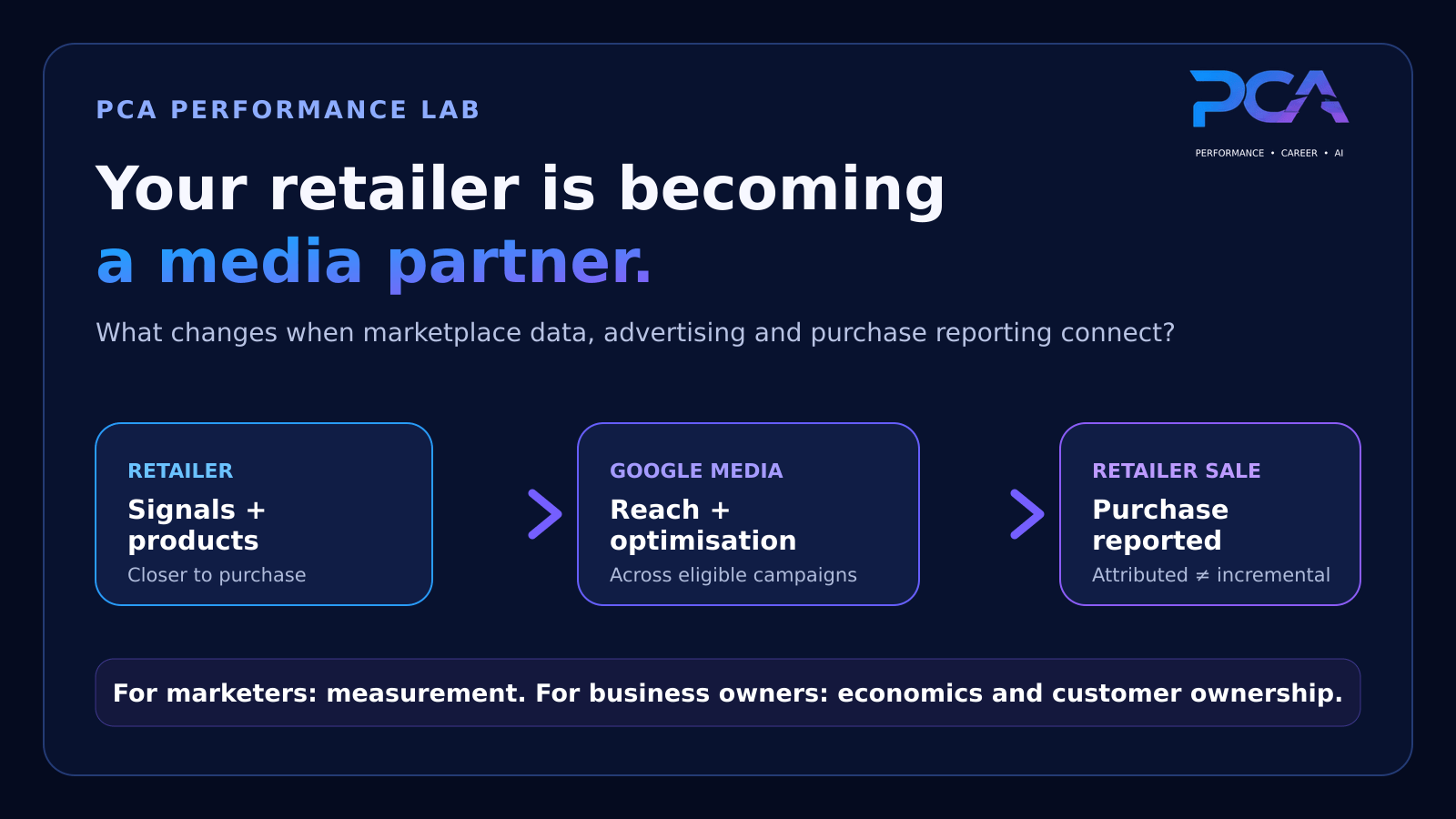
Imagine a footwear brand wants to sell more running shoes. Instead of sending every Google ad to its own website, it can use an eligible retailer’s selected signals and product catalogue, send shoppers to that retailer’s product page, and receive product-level purchase reporting.
That is the useful promise behind commerce media. It is also where the questions begin: Who owns the customer relationship? Is the sale profitable after marketplace fees and discounts? Did the advertising create an additional purchase—or simply receive credit for one that was already likely?
What Google announced
On 24 September 2026, Google highlighted the expansion of its Commerce Media Network. Google’s documentation describes a setup in which participating retailers or marketplaces can make selected first-party signals, product catalogues and conversion information available for eligible advertising activity. Brands can use that collaboration across supported Google campaign types and measure product-level outcomes reported by the commerce partner.
This is not the same as a new universal checkout button, and it does not mean a retailer hands raw customer data to every advertiser. Availability, data access and reporting depend on the participating commerce partner and the specific setup.
Retail media and commerce media—in plain language
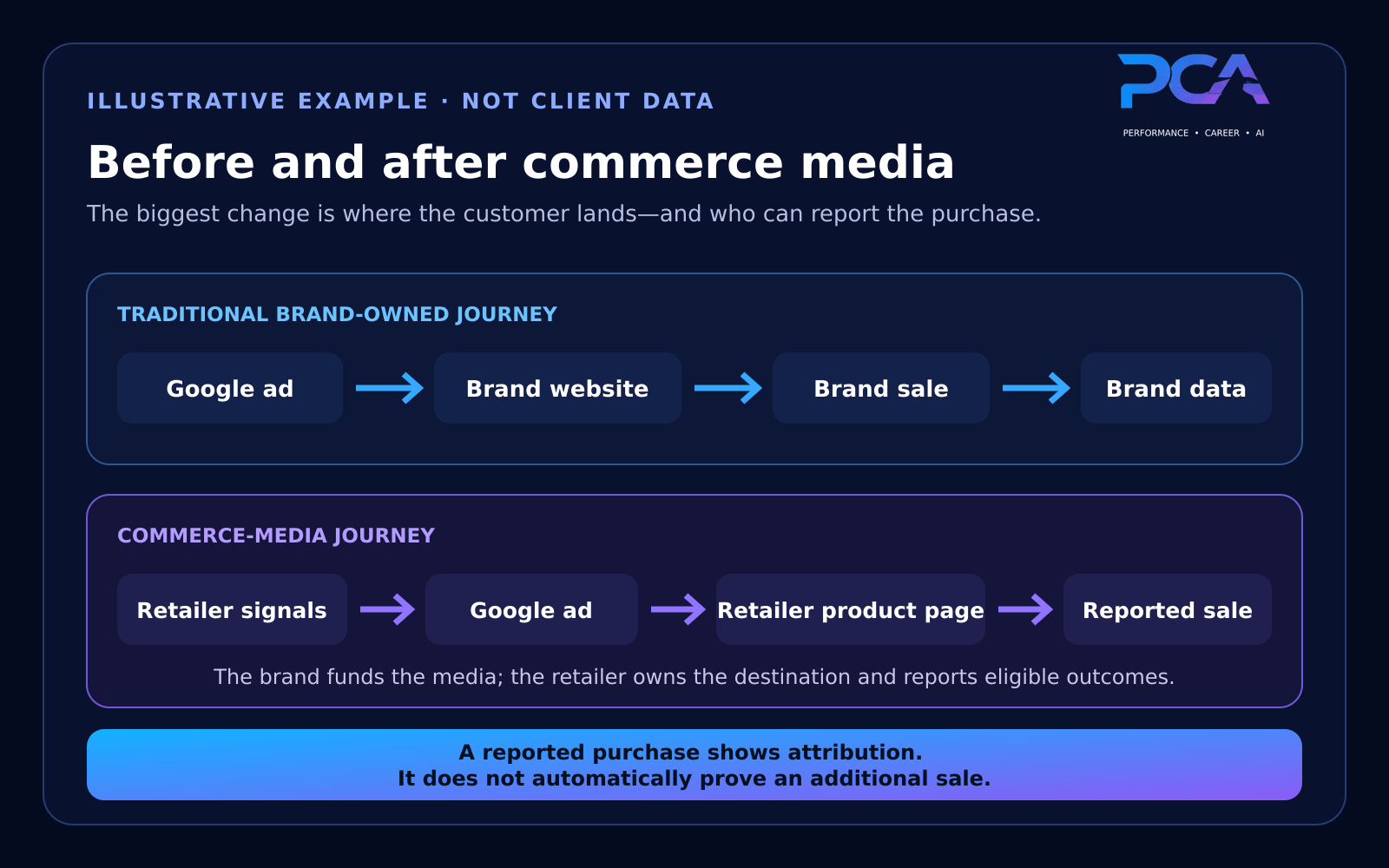
Illustrative example—not client data.
A simple example: FitRun Shoes
Consider a fictional brand called FitRun Shoes.
Before: FitRun runs a Google ad, sends the shopper to its own website, completes the order there and records the customer and purchase in its own systems.
With commerce media: a participating marketplace shares eligible product and shopping signals for the collaboration. FitRun funds a Google campaign. The shopper lands on FitRun’s product page inside the marketplace. The marketplace completes the order and reports an eligible product-level conversion.
The second route can shorten the path to purchase because the shopper may already trust the marketplace, have saved payment details and expect familiar delivery or returns. But a shorter path does not automatically mean a better business outcome.
What the reporting can tell you
- Which eligible products were promoted.
- Which retailer-reported purchases were attributed to the campaign.
- Product-level performance signals available within the collaboration.
- How campaigns, products and budgets performed according to the platform’s reporting rules.
What it cannot prove by itself
Suppose the retailer reports 10 purchases after people interacted with the campaign. Those 10 are attributed outcomes. They do not automatically prove that advertising created 10 additional purchases.
If seven of those shoppers would have bought anyway—through marketplace search, an existing brand preference, another channel or seasonal demand—the campaign may have added only three purchases. The exact number requires a credible test or comparison; it cannot be inferred from the attributed count alone.
What performance marketers need to understand
For marketers
- Map the full journey: signal, ad, destination, purchase and reporting source.
- Check retail readiness: eligible products, inventory, pricing, reviews and product-page quality.
- Separate attribution from incrementality: do not rename retailer-reported conversions “new sales” without evidence.
- Reconcile channels: compare marketplace, brand-site, other marketplace and blended sales.
- Watch movement: an increase on one retailer may partly shift demand from another channel.
For business owners
- Choose the sale destination: your website and a marketplace create different economics and customer relationships.
- Count complete costs: media, commission, discount, fulfilment and returns.
- Decide what customer ownership is worth: marketplace convenience can reduce direct customer visibility.
- Define the objective: new customer, incremental sale, product launch or marketplace growth.
- Start with a controlled pilot: clear products, budget, period and success rules.
The PCA Commerce Media Accountability Map
Before approving a test, put five decisions on one page:
Should your business test it now?
| Test | Prepare | Wait |
|---|---|---|
| Marketplace sales already matter, priority SKUs have stable inventory and product pages are competitive. | The opportunity fits, but catalogue quality, conversion setup, margins or measurement rules need work. | Margins are unclear, inventory is unstable, customer ownership is essential, or the retailer collaboration is unavailable. |
Google’s setup guidance also notes practical eligibility and readiness requirements, including an approved product set, sufficient learning time and a viable daily budget. Treat these as platform starting conditions—not proof that the commercial case works for your brand.
The career lesson for marketers
Commerce media makes media buying, retail operations and commercial measurement harder to separate. The valuable marketer will not merely launch the campaign. They will connect catalogue health, inventory, channel economics, attribution, experimentation and the business objective.
In other words: the platform can optimise within the system. The marketer must decide whether the system is optimising something worth paying for.
PCA Commerce Media Readiness Review
Should your brand test, prepare or wait?
PCA Engine can review your website-to-marketplace sales mix, product and inventory readiness, channel economics, customer-ownership trade-offs, retailer reporting and measurement plan—then turn them into a practical pilot recommendation.
Discuss a readiness review