
Your CRM shows 100 enquiries. Google Ads shows 45 conversions. Does that mean Google has lost 55 leads?
No. The two systems may be counting different things. Your CRM can contain enquiries from every source, while Google Ads reports conversions it can attribute to ad interactions under the account’s tracking and attribution settings. Comparing those two totals without checking their definitions can produce the wrong conclusion.
Google’s 10 September 2026 measurement announcement introduces closer Data Manager integration with Google Analytics and Display & Video 360 (DV360), connection diagnostics, and a Data Strength Uplift metric in Google Ads. These changes deserve attention. But they do not invent offline conversion uploads or customer matching. Advertisers could already send offline outcomes to Google and connect them to earlier ad interactions.
The useful question is: Does this update help us connect, monitor and interpret the right business outcomes more reliably?
First, separate the CRM count from the Google Ads count
Here is an illustrative example, not a client result or an expected match rate:
| Stage | Illustrative count | What it means |
|---|---|---|
| Enquiries in the CRM | 100 | All sources combined |
| Enquiries that followed Google Ads interactions | 60 | An illustrative subset of the 100; attribution depends on the applicable rules and data |
| Enquiries Google Ads can initially attribute | 45 | The subset connected and reported under this example’s setup |
| Enquiries Google Ads can attribute after improved matching | 55 | Ten additional existing outcomes are now connected in this illustration |
The business received 100 enquiries before and after. The illustrative change from 45 to 55 is an improvement in identifying and reporting ad-related outcomes. It is not evidence that advertising generated ten additional enquiries. Nor does it mean the other 45 CRM records should appear in Google Ads; many may have come from other channels or may fall outside the relevant attribution conditions.
The exact count in a real account also depends on event definitions, attribution settings, reporting dates, consent, identifiers and the quality of the imported records. A stronger connection cannot guarantee that every CRM record will be attributed.
What advertisers could already do
Advertisers have long been able to import offline conversions, such as a lead progressing to a sale after a phone call. Google can use an eligible click identifier or, with enhanced conversions for leads, permitted first-party customer information to help associate that later outcome with an earlier ad interaction. Google’s offline conversion guidance describes these established workflows.
Data Manager itself was already available in Google Ads. Its existing documentation describes connecting a source once and using that connection for more than one destination, such as enhanced conversions for leads and Customer Match. Google had also announced a Data Manager API in December 2025. So neither “upload offline outcomes” nor “reuse a connection” should be presented as a brand-new capability in September 2026.
What Google announced in September 2026
Closer integration across tools. Google says it is directly integrating Data Manager into Google Analytics and DV360, alongside Google Ads, to help advertisers manage and activate first-party data across those products. This is an expansion of where teams work with the data, not a new definition of a conversion. The exact options available should be checked in each account. Source: Google
More visible connection problems. New built-in diagnostics can flag issues such as failed credentials, a missing required column, an unsuccessful import or inconsistent transaction IDs that might cause overcounting. Google’s diagnostics guide says this feature is rolling out gradually, so it may not be visible in every account yet.
A metric for recovered reporting. Google describes Data Strength Uplift as a metric calculating additional conversions recovered through an advertiser’s first-party-data setup. In plain language: stronger matching may allow Google Ads to report existing conversions it previously could not connect. Google has not described this metric as a test of whether the advertising *caused* additional sales. Source: Google
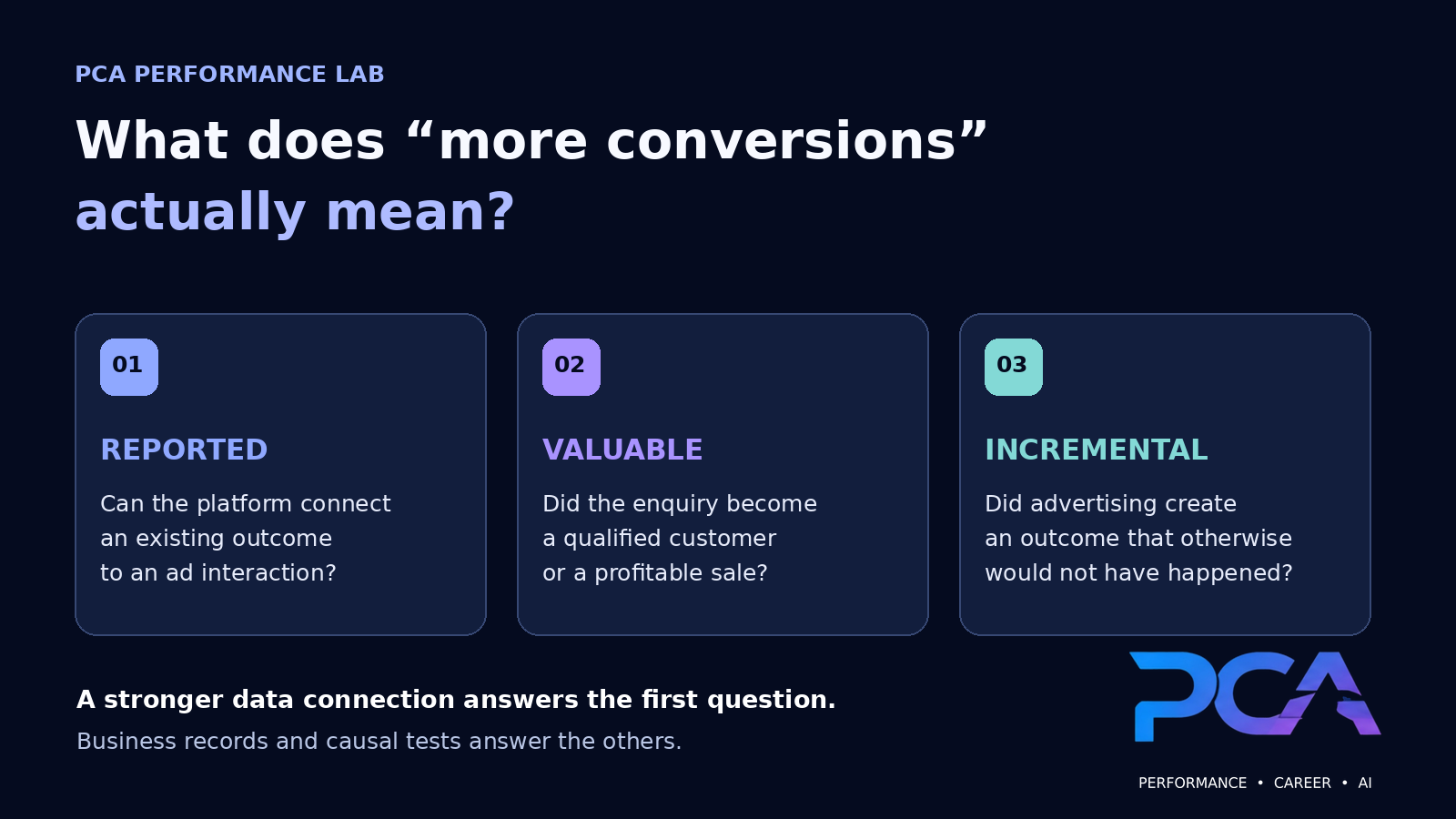
Three meanings of “more conversions”
This is where dashboard conversations can become confusing:
- Recovered conversions: More existing outcomes can be matched and reported.
- Valuable conversions: More of those outcomes become qualified leads, paying customers or profitable sales.
- Incremental conversions: More outcomes happened because advertising ran than would have happened without it.
Data Strength Uplift addresses the first question. CRM and commercial records help evaluate the second. The third requires an appropriate causal measurement method; an attribution count alone cannot establish it. Google discusses causal geo experiments separately in the same September announcement.
Why the signal sent back matters more than the upload itself
Suppose an app campaign produces 1,000 installs, followed by 300 trials and 80 paid subscriptions. If its bidding goal is installs, the system is being asked to find people likely to install. It cannot infer from that instruction alone that a retained paying subscriber is the business’s preferred outcome.
The marketer and business should decide which event represents useful progress, whether it can be measured reliably, and which actions should guide bidding. In Google Ads, primary conversion actions generally feed the selected bidding goal, while secondary actions are generally for observation; campaign and custom-goal settings can affect the effective optimisation setup. Check the campaign’s actual goals before changing any designation. Google Ads: primary and secondary actions
For lead-generation businesses, a similar journey is form submitted → qualified lead → sale. Sending a later CRM outcome back can provide a signal closer to business value than a form submission alone. That does not mean every account should immediately switch bidding to sales: first check volume, delay, data quality and whether the imported outcome is reliable.
The PCA Signal-to-Value Audit
Before celebrating a higher reported conversion count, check five things:
- Capture: Are meaningful events recorded consistently and only once? Check the website/app event and imported record for duplication.
- Connect: Are identifiers and CRM fields present and formatted correctly? Is the connection importing on time, and are diagnostics clear?
- Classify: Which exact conversion actions are used by the campaign’s bidding goal? Which are observed separately?
- Qualify: Can you distinguish an enquiry or trial from a qualified lead, paid subscription or completed sale?
- Compare: Did only platform attribution increase, or did qualified outcomes and business revenue also change?
For a business owner, this audit produces a practical answer: what is the ad platform learning from, and does that event resemble a valuable customer? For a marketer, it identifies whether the immediate job is to repair measurement, import later outcomes, adjust a goal or investigate the gap between platform and CRM reporting.
What to do this week
Start with one campaign and one clearly defined reporting period. Export its conversion actions and check the goals actually used for bidding. Then compare the relevant actions with CRM or payment records for the same cohort, allowing for sales delay. Review Data Manager connection health and import errors if the account uses it. Document what each figure means before changing budgets or bidding targets.
If Data Strength Uplift appears in the account, read it as additional conversions reported through stronger first-party-data setup. Check which conversion actions contributed and whether those actions lead to qualified customers. Do not call the uplift “incremental sales” without a separate causal test.
The decision that still belongs to people
Google is making data connections easier to manage and problems easier to spot. Those improvements can make measurement more complete. They cannot decide whether a form submit, qualified lead, paid subscription or profitable customer is the right goal for your business.
The better question after this update is therefore not simply, “Did Google Ads report more conversions?” It is “What exactly did it recover, and what outcome are we asking AI to pursue?”
PCA Engine helps brands and marketing teams map their website, app and CRM signals to business outcomes. If your platform and CRM numbers disagree—or campaigns optimise for an event that does not reflect customer value—discuss a Signal-to-Value Audit with Meenaa. A discovery conversation can identify initial priorities; a detailed assessment and roadmap are scoped separately.