
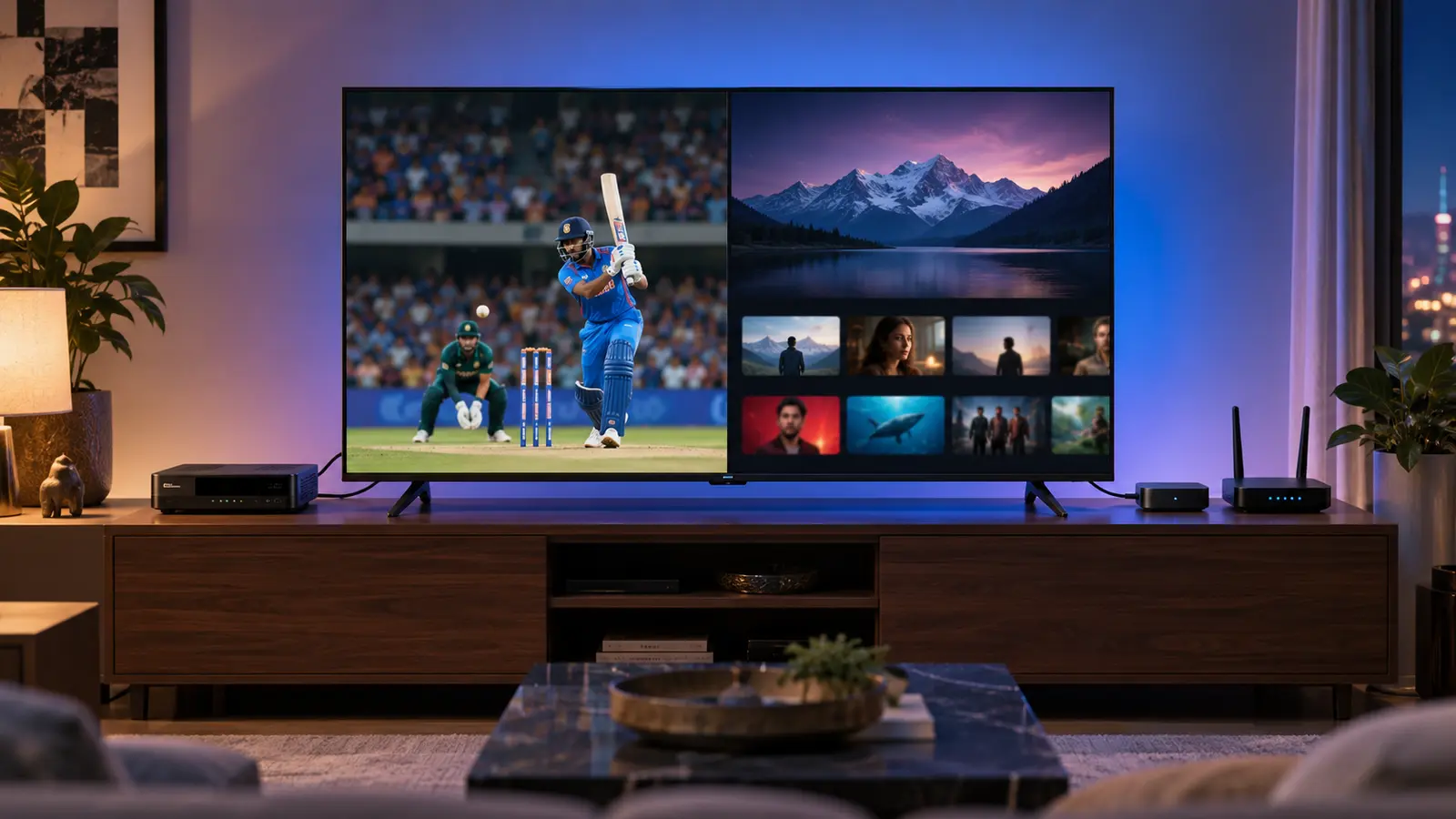
A smart television is not automatically Connected TV advertising.
If you watch Star Plus through a cable or DTH connection on a smart television, you are watching Linear TV. If you open JioHotstar, YouTube, SonyLIV or another streaming app on the same television through the internet, you are in a Connected TV environment.
If you watch the same streaming service on a mobile phone, it remains OTT or digital video, but it is not CTV because the viewing device is not a television.
The simplest rule: the screen alone does not define the media. First identify how the content arrived, where it was watched and how the advertising was purchased.
Why this distinction matters now
India’s television market is currently dealing with two separate developments: the continuing BARC television-ratings blackout and the repeal of the earlier 12-minute-per-clock-hour advertising ceiling for television channels. These developments concern the traditional television ecosystem, its audience currency and the flexibility available to broadcasters. BARC ratings update · Advertising-duration update
At the same time, marketers increasingly discuss CTV, OTT and Display & Video 360 (DV360) as though every advertisement appearing on a television screen belongs to the same buying system. It does not.
A conventional Star Plus broadcast slot and a targeted video impression inside an internet-connected streaming app may appear on the same physical television. But they can involve different sellers, buying routes, targeting options, reporting systems and standards of evidence.
What is Linear TV?
Linear TV is traditional scheduled television delivered through a broadcast, cable or Direct-to-Home (DTH) service. The viewer watches programmes according to the channel’s schedule.
Examples include watching Star Plus, Zee News or NDTV through Tata Play, Airtel Digital TV, Dish TV or a local cable operator. The television itself may be smart or non-smart; that does not change the delivery into CTV.
Advertising slots are typically negotiated through broadcasters, television networks, media agencies or specialist television-buying partners. The buy may be organised around channels, programmes, genres, dayparts, spot lengths, markets and expected ratings.
What is Connected TV?
Connected TV describes television viewing in which video content reaches the television through an internet connection. Google defines CTV as television sets used to stream internet-delivered video, including smart TVs, streaming devices, connected set-top boxes and gaming consoles. Source: Google Display & Video 360 Help
A television can become part of a connected environment through:
- A built-in smart-TV operating system
- An Amazon Fire TV Stick, Chromecast or Apple TV device
- An internet-connected set-top box
- A gaming console running a streaming application
CTV therefore refers to the internet-connected television viewing environment, not one manufacturer, streaming service or advertising platform.
What is OTT, and why is it not the same as CTV?
OTT means video content delivered “over the top” of traditional cable or satellite distribution through the internet. It describes the delivery of content, not necessarily the screen on which it is watched.
| Viewing situation | OTT? | CTV? | Why? |
|---|---|---|---|
| JioHotstar on a smart television | Yes | Yes | Internet-delivered content viewed on a television |
| YouTube on a Fire TV Stick | Yes | Yes | Internet video delivered to a connected television |
| JioHotstar on a mobile phone | Yes | No | Internet-delivered video, but the device is not a TV |
| Star Plus through Tata Play | No | No | Scheduled channel feed delivered through DTH |
| Star Plus live inside an internet streaming app on TV | Yes | Yes | The programme may be live, but delivery is internet-based and the device is a TV |
“Live” does not automatically mean Linear TV. A live channel or sporting event streamed through an internet app can still be OTT and, when watched on a television, CTV.
What does DV360 actually buy?
DV360 is Google’s enterprise platform for planning, buying, managing and measuring digital media. Its Connected TV workflow is designed for digital television and OTT inventory available through eligible publishers, exchanges and deals.
Google describes CTV insertion orders as a workflow for buying television and OTT content on connected-TV devices. Depending on availability, advertisers may use curated CTV auction inventory, publisher deals, Programmatic Guaranteed arrangements or YouTube & partners on CTV. Connected TV insertion orders · Connected TV line items
In practical Indian media planning, this means DV360 can be used to buy eligible internet-delivered CTV and OTT impressions. A conventional advertisement appearing inside the normal Star Plus cable or DTH feed is not automatically purchased through a standard DV360 CTV line item.
Why does DV360 mention Linear TV?
This is where planning and buying are frequently confused.
DV360 includes tools that can compare estimated reach and frequency across digital media and Linear TV in supported markets. Google’s documentation states that these plans use historical television data and measurement providers to compare Linear TV with YouTube, third-party video and CTV.
That does not mean every Linear TV spot in every market can be purchased through a normal DV360 digital line item. Google’s published support list for Linear TV and digital planning currently names the United States, Japan, Vietnam, France and Germany—not India. Source: Google
Planning is not buying. A platform may use television data to forecast or compare media without serving the underlying broadcast advertisement itself.
What can DV360 report for CTV?
For eligible CTV activity, DV360 can provide digital delivery signals such as impressions, device type, app or inventory identifiers, estimated unique reach, frequency and campaign-level performance reporting. Google also provides co-viewing-adjusted reach estimates because multiple people may watch the same television. CTV reporting and forecasting · Co-viewing measurement
Where the advertiser’s measurement setup and inventory permit, CTV exposure may also be evaluated alongside website, app or business outcomes.
However, a served impression does not independently prove that a person was present, looked at the screen, remembered the advertisement or purchased because of it. Google notes that direct viewability measurement is not always possible on CTV and gaming-console inventory; some measurement may be inferred. Source: Google Ad Manager Help
This is why a high video-completion rate should not automatically be described as equivalent human attention.
How Linear TV and CTV measurement differ
| Question | Linear TV | CTV through DV360 |
|---|---|---|
| Was the advertisement distributed? | Spot logs or broadcaster confirmation | Platform impression and delivery reporting |
| Who may have been reached? | Panel-based audience estimates and television currency | Platform-estimated users or households, subject to coverage and modelling |
| Where did it appear? | Channel, programme and daypart | App, publisher, deal or inventory source where reporting is available |
| How often? | Planned and estimated frequency | Digital frequency reporting and caps, subject to identity limitations |
| Did it create business impact? | Requires business-outcome analysis or experiments | Also requires business-outcome analysis or experiments |
Neither system should be treated as automatic proof of causality. Audience delivery, platform attribution and incremental business impact answer different questions.
The PCA TV Buying Clarity Map
Before approving a plan labelled “TV,” “OTT” or “CTV,” ask these four questions:
- Delivery route: Did the content reach the viewer through cable/DTH or through the internet?
- Viewing device: Was it watched on a television, mobile phone, desktop or tablet?
- Buying method: Was the advertising bought through a broadcaster/media-agency agreement or a digital/programmatic platform and publisher deal?
- Measurement source: Are the numbers coming from an independent audience currency, a publisher, the buying platform, the advertiser’s analytics or a controlled experiment?
If the proposal cannot answer all four, the media label is not yet precise enough for an informed investment decision.
A practical pre-buy checklist
- Which exact apps, publishers, channels or deals are included?
- Is the inventory CTV-only, multi-device OTT or a broader digital-video package?
- Which geography and audiences are actually available in India?
- How will frequency be controlled across apps and devices?
- Will reporting show app or publisher-level delivery?
- How are co-viewing and household reach estimated?
- Which conversion or business outcomes will be compared with exposure?
- Is any reach, attention or sales claim platform-reported, independently measured or experimentally tested?
The decision that still belongs to the marketer
CTV offers digital buying flexibility and more granular delivery signals than a conventional broadcast buy. That does not make every CTV impression better than Linear TV, nor does it make the platform dashboard an independent source of truth.
The marketer’s job is to match the media environment with the business objective, verify what is actually being purchased and separate delivery from attention, attribution and incremental impact.
How did the content reach the screen, how was the advertisement purchased, and what evidence will tell us whether the investment worked?
PCA Engine helps brands and marketing teams review media plans across Linear TV, OTT, CTV and digital buying. If a proposal mixes screens, inventory types or measurement claims without explaining the differences, discuss a TV and CTV Media Clarity Review with Meenaa. Initial priorities can be discussed first; a detailed audit and roadmap are scoped separately.