
PCA PERFORMANCE LAB
When Ads Become AI Agents: What Happens to Landing Pages and Conversion Measurement?
Most digital advertising asks a person to click and continue the journey somewhere else. But what changes when the advertising experience can answer questions, understand needs and guide the next action inside a conversation?
On 16 September 2026, Reuters reported that OpenAI had introduced new AI-powered tools for advertisers and begun testing business-sponsored chat agents within ChatGPT. This is an early test—not a generally available advertising product—and its eventual form may change. Yet the direction deserves attention because it suggests something bigger than another placement in a media plan.
A conventional ad normally attracts attention and sends the prospective customer to a website, marketplace, app or form. A conversational advertising experience could potentially answer questions, explain options and qualify intent before that person reaches the brand’s existing destination.
From “click to continue” to “ask to continue”
The familiar performance-marketing journey often looks like this: an ad earns a click, a landing page explains the proposition, a form captures the lead and a person or automated workflow follows up.
An emerging conversational journey may compress some of those visible steps. The customer could ask a question, clarify requirements, receive an appropriate option and then complete an action or move to a human representative.
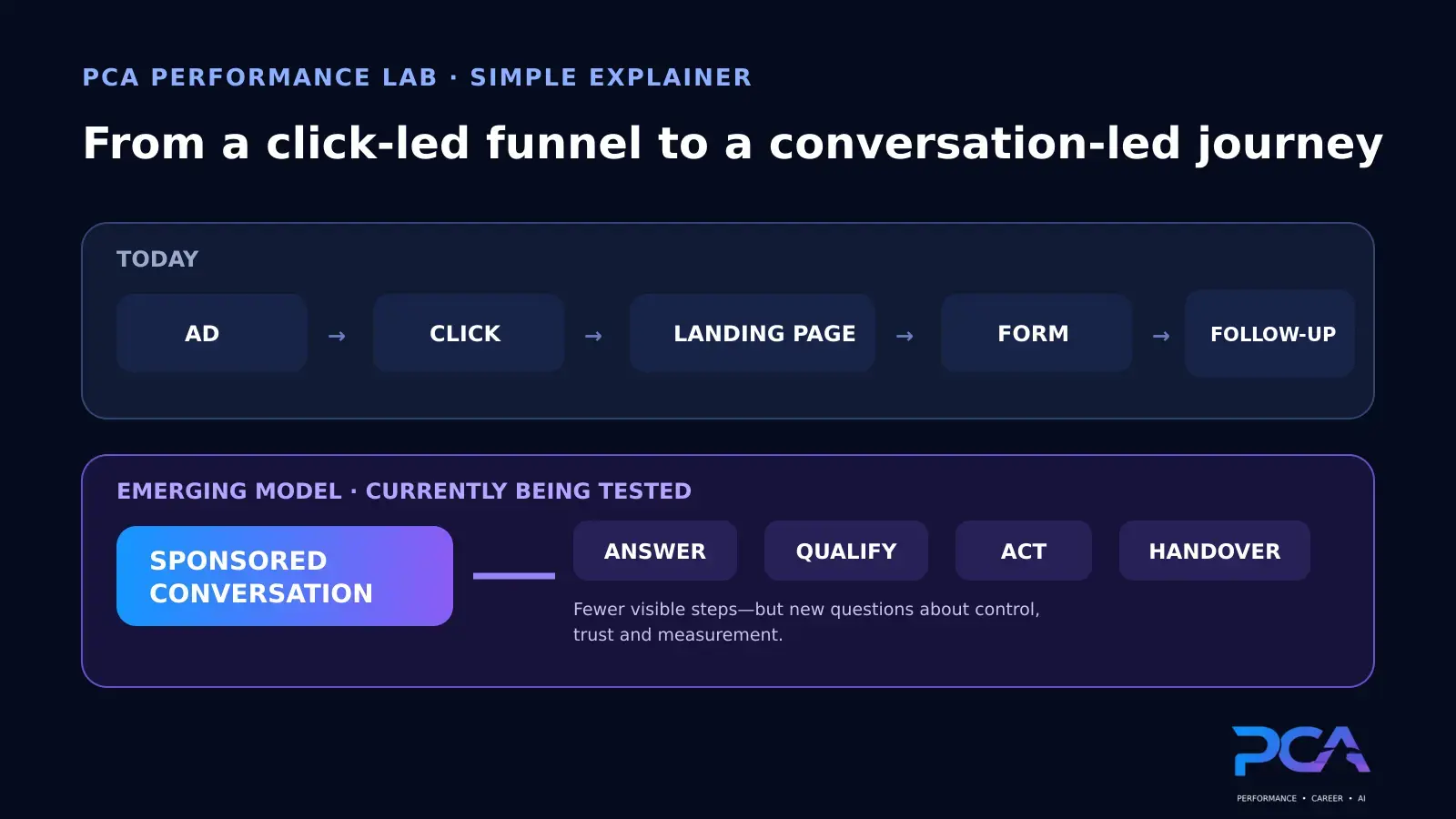
This does not automatically make the journey better. A shorter route can reduce friction, but it can also hide uncertainty. If the agent uses outdated pricing, misunderstands eligibility or makes a promise the business cannot honour, the conversation has accelerated the wrong outcome.
Will AI agents replace landing pages?
Probably not as a blanket rule. Landing pages perform jobs that extend beyond lead capture. They establish credibility, provide structured proof, explain complex products, display terms and policies, support search discovery and give customers a destination they can revisit.
For a simple product with clear pricing, a conversation may answer enough questions to move directly towards purchase. For a high-consideration service, financial product, enterprise solution or customised offering, the website may remain essential.
The more useful question is not, “Will landing pages disappear?” It is:
Which parts of this customer journey require information, which require persuasion, which require qualification—and which require human judgement?
The new measurement problem
Performance marketing has historically relied on measurable transitions: impression, click, page view, form submission, qualified lead and sale. A conversational agent can introduce new intermediate events:
- Conversation started
- Meaningful question asked
- Need or eligibility identified
- Recommendation presented
- Customer handed to a person
- Transaction or appointment completed
If the dashboard rewards only conversations started, the system may learn to begin many conversations without producing valuable customers. If it rewards only the final sale, the data may arrive too slowly or too sparsely for useful optimisation.
This resembles the signal problem already faced in lead generation: a form submission is measurable, but a qualified opportunity is commercially more meaningful. PCA’s earlier guide on offline outcomes and Google Data Manager explains why stronger matching does not automatically mean stronger business value.
What marketers need to understand
- Conversation quality will need a definition. More interactions do not necessarily mean more purchase intent.
- The source of truth matters. Product information, availability, eligibility and pricing must come from approved, maintained sources.
- Handover is part of campaign design. The customer should not be trapped inside automation when the situation requires a person.
- Downstream outcomes still matter. CRM, payment and retention data may be needed to distinguish attention from commercial value.
- Optimisation remains an accountability decision. AI can pursue an objective; people must decide whether the objective represents the business.
What business owners need to decide
A business owner does not need to understand every technical component. But the owner must establish the boundaries within which an agent may represent the organisation:
- Which claims can it make?
- Can it quote prices or discounts?
- May it recommend one product over another?
- What customer information may it request?
- Which cases require immediate human intervention?
- Who owns the outcome when the advice is wrong?
These are not merely chatbot settings. They are commercial, customer-experience and brand-governance decisions.
The PCA Agentic Conversion Contract
Before allowing an AI-led experience to participate in customer acquisition, PCA recommends documenting five controls.
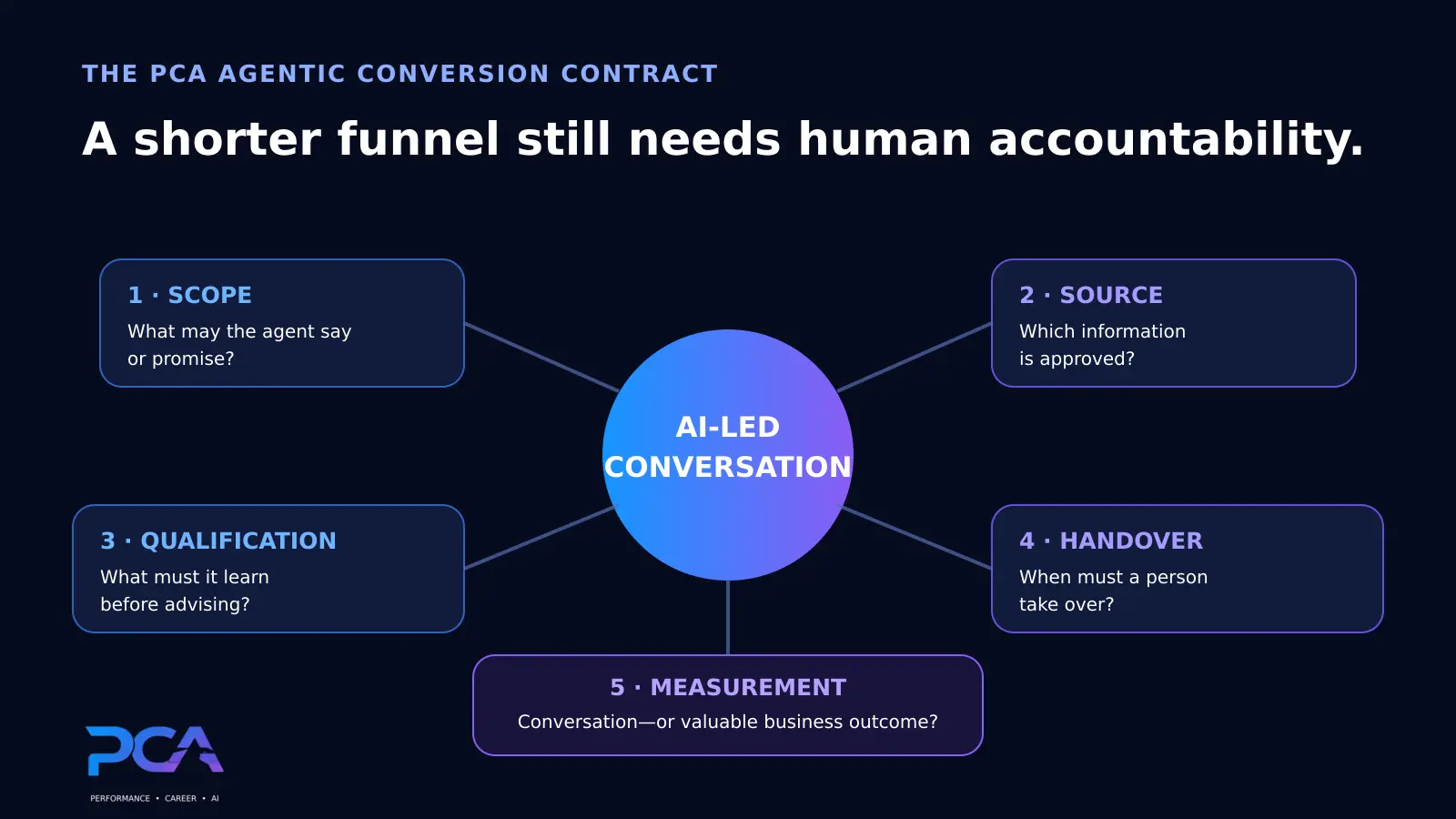
1. Scope
Define what the agent may answer, recommend, calculate or promise—and what it must refuse or escalate.
2. Source
Identify the approved product catalogue, service rules, pricing, inventory, policies and exclusions it may use.
3. Qualification
Specify what the agent must learn before suggesting an option. A recommendation without sufficient context may create speed without relevance.
4. Handover
Define the conditions, ownership and response time for moving the customer to a person, CRM queue, appointment or checkout.
5. Measurement
Separate conversational activity from qualified outcomes and commercial results. Decide what the system should learn from—not merely what is easiest to count.
A practical agent-readiness exercise
Choose one live campaign and write its journey from first exposure to revenue. Against every stage, mark one of five jobs: inform, persuade, qualify, transact or apply judgement.
Then ask:
- Which stages could safely happen through a conversation?
- What approved information would the agent require?
- What could go wrong if it misunderstood the customer?
- Where should a person take over?
- Which downstream outcome would prove that the journey created business value?
This exercise is useful even before sponsored agents become widely available. It exposes gaps in landing pages, lead qualification, CRM handovers and conversion definitions today.
The role of the performance marketer is moving upstream
If interfaces become more conversational, the valuable skill will not be knowing where to place another button. Marketers will need to connect customer intent, approved knowledge, measurement signals, commercial economics and human escalation.
Clicks may reduce. Accountability will not.
Is your customer journey ready for AI-led conversations?
PCA Engine helps brands and marketing teams map acquisition journeys, conversion signals and human handovers before automation is introduced. A discovery conversation can identify initial priorities; detailed diagnostics, implementation roadmaps and workshops are scoped separately.
Source
Editorial note: The customer journeys and framework in this article are PCA Engine analysis. They illustrate possible operating implications of the reported test and do not represent a confirmed final product design or availability commitment from OpenAI.