
PCA PERFORMANCE LAB
Quick-Commerce Marketing Is Hyperlocal: A Practical Guide for Brands and Marketers
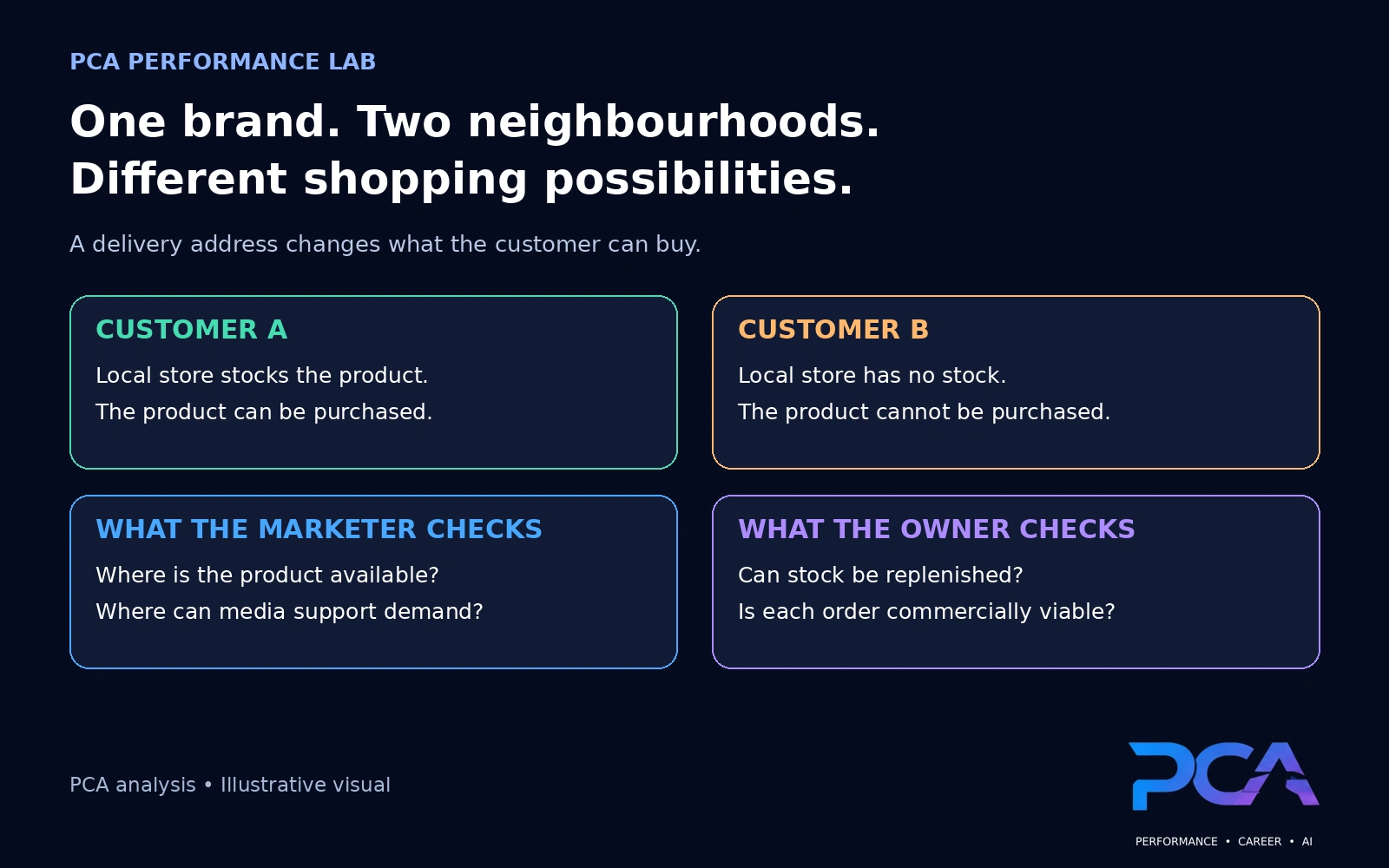
Two customers can see the same brand campaign and have completely different shopping experiences. One can buy the advertised product immediately. The other enters a delivery address and discovers that the product is unavailable. The difference may be local stock rather than the ad.
What does hyperlocal mean in quick-commerce marketing?
Hyperlocal means that the opportunity to sell depends on a small delivery area. Quick-commerce platforms fulfil orders from nearby facilities, often called dark stores: local warehouses used to prepare online orders rather than serve walk-in shoppers.
The catalogue a customer can buy depends on the delivery address, the serving store, available stock and current service conditions. Two nearby customers may therefore see different availability. A pin code is a useful planning label, but it is not necessarily the exact delivery boundary. Store catchments can overlap or divide a pin code.
A September 17, 2026 Financial Express report describes regional festive storefronts and local assortment planning, with dark stores typically serving a radius of around two to three kilometres. Treat that as reported market context, not a fixed rule for every platform or location.
Why local availability belongs in the marketing conversation
Performance marketers normally review audiences, creative, bids, product pages and conversion rates. Quick commerce adds a dependency: the advertised stock must exist where the shopper is buying.
This matters for both broad campaigns that send shoppers to a platform and sponsored placements inside that platform. However, these are different buying environments. An external campaign can reach people outside a serviceable area. An in-platform placement may apply availability rules automatically. Do not assume that every platform serves ads for unavailable products, or that every advertiser can control spend at dark-store level.
The useful action is to check the actual campaign controls, stock rules and reporting available in your account. Blinkit's official brand portal, for example, describes advertising and performance tools for brands; it does not establish identical functionality across all quick-commerce platforms.
A simple example: four areas, four decisions
Imagine a sweets brand reviewing the same product across four delivery areas. The following is fictional planning data, not a client result or a forecast. Assume the brand has checked which locations it can serve and which media adjustments its setup allows.
| Area | Local situation | What to investigate | Possible next action |
|---|---|---|---|
| A | Demand and stock are strong | Margin and replenishment capacity | Test additional visibility within limits |
| B | Demand is strong; stock is low | Stock cover and next delivery | Coordinate replenishment before scaling |
| C | Stock is strong; demand is weak | Price, relevance and discoverability | Diagnose the constraint before spending more |
| D | Demand and stock are strong; paid visibility is low | Existing organic sales and media opportunity | Test paid support; do not assume all demand is uncaptured |
The example does not prove that stock explains every performance difference. Competition, pricing, offer quality, placement and customer preferences can also matter. Its purpose is to prevent one convenient explanation—“the creative is weak”—from replacing a complete diagnosis.
The PCA Pin-Code Performance Stack
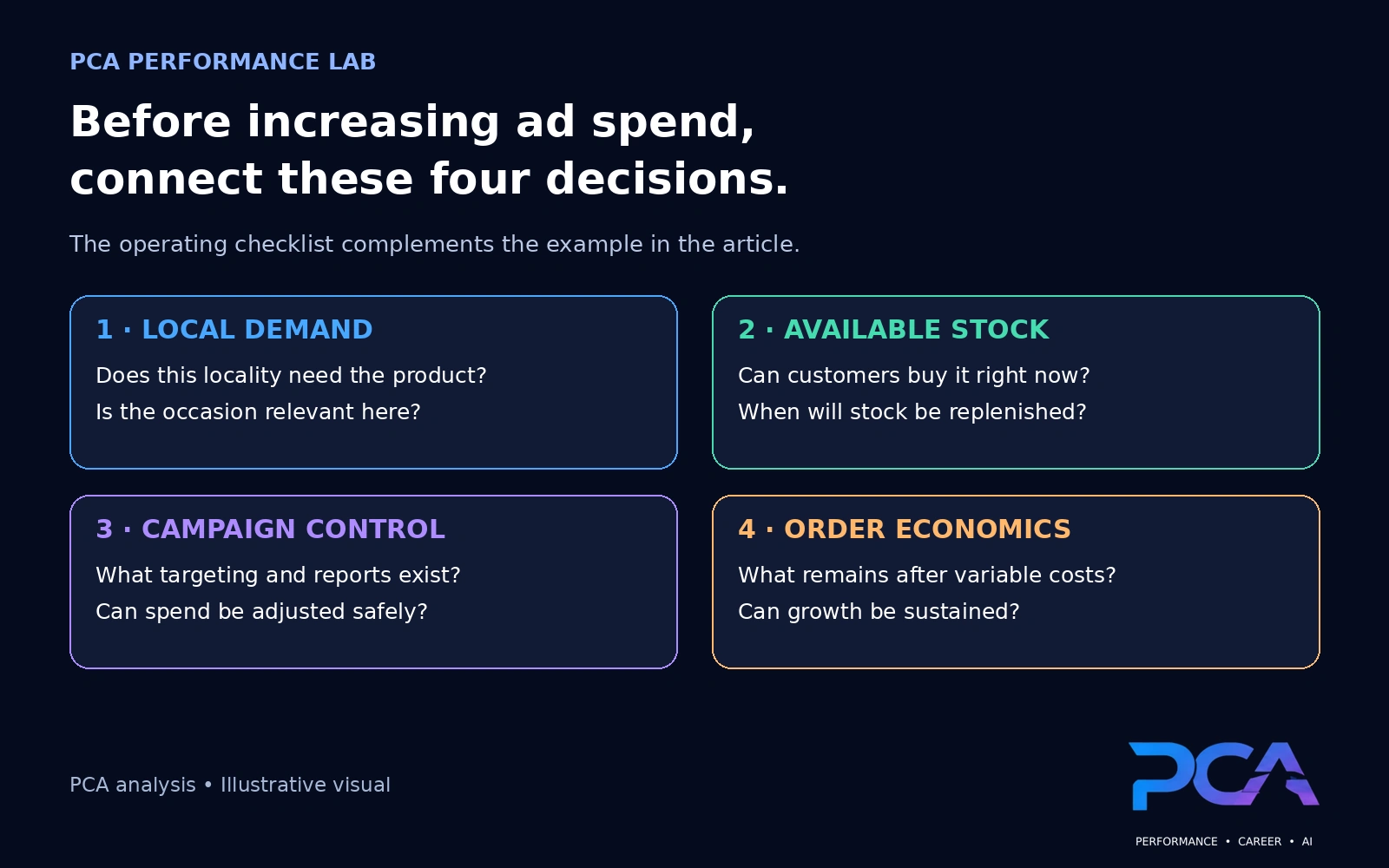
PCA recommends checking six connected factors. This is our planning framework, not a platform feature.
- Demand: Which products and occasions are relevant to the locality?
- Availability: Can the customer buy the specific product and pack size now?
- Visibility: Can shoppers find it through organic discovery or paid placements?
- Delivery: Is the address serviceable, and is the displayed promise acceptable?
- Economics: What remains after product cost, applicable platform charges, brand-funded discounts, media and other variable costs?
- Replenishment: Can the business restore stock before the next demand peak?
What performance marketers should do
Start with the data the platform actually provides. If store-level reporting exists, use it. If only city or product-level reporting is available, document that limitation and combine it with permitted availability checks and stock reports. Avoid presenting estimated local sales as measured results.
- Review availability alongside spend, impressions, orders and conversion rate at the finest reliable level.
- Record price and offer changes so comparisons are interpretable.
- Separate low-stock periods from periods with healthy stock where possible.
- Confirm whether unavailable items are excluded automatically from sponsored placements.
- Agree when to reduce, pause or restore media, within available controls.
- Check whether an apparent winner is benefiting from better stock or a stronger offer.
Your role is to identify the constraint and recommend an appropriate response. That makes collaboration with the brand and its operations team part of effective campaign management.
What business owners should do
Give the marketing team access to useful operational context. A campaign manager cannot make a reliable stock-aware recommendation from an advertising dashboard alone.
- Assign an owner for inventory updates and replenishment escalation.
- Share product-level economics and explain which discounts the brand funds.
- Confirm where products are listed and serviceable before promoting availability.
- Agree a stock threshold for reviewing spend rather than using a universal rule.
- Coordinate occasion-specific packs with the locations where demand is expected.
Listing on more platforms can increase opportunity, but it also increases operational complexity. Choose the product, locations and service commitments the business can support consistently.
Revenue can grow while contribution shrinks
Here is a separate illustrative calculation for one order. Suppose realised revenue is ₹500, product cost is ₹250, platform and fulfilment charges total ₹80, a brand-funded discount costs ₹50, and allocated media cost is ₹70. That leaves ₹50 contribution before fixed costs and any other applicable costs.
These are invented figures. Use a consistent accounting basis and avoid subtracting a discount twice if realised revenue is already net of it. Actual contracts, taxes, returns, spoilage and charge structures differ. The lesson is to review contribution alongside revenue and ROAS.
A seven-day readiness exercise
- Day 1: Select one product and one city; confirm listings and available data.
- Day 2: Map service areas or store catchments where known.
- Day 3: Review availability and record missing stock information.
- Day 4: Check price, offers and product-page clarity.
- Day 5: Calculate contribution using actual commercial terms.
- Day 6: Agree media-review triggers with the stock owner.
- Day 7: Choose one limited test with a hypothesis, budget cap and review date.
This is a diagnostic week, not a promise of measurable sales lift within seven days. Avoid comparing different locations as if they were a randomised experiment.
Common questions
Can I target every campaign by pin code?
Not necessarily. Controls and report granularity vary by platform, placement and account. Verify your setup before designing a plan around that capability.
Does no advertising mean no sales?
No. Organic search, repeat purchases, category browsing and other activity may already generate sales. Paid visibility is one contributor.
Does higher attributed ROAS prove advertising created more purchases?
No. Attribution records credit under the platform's rules. Demonstrating additional purchases caused by advertising requires suitable incrementality measurement. Our festive ROAS guide explains the distinction.
Where does AI help?
It can assist with summarising reports or identifying patterns when reliable inputs are available. People still need to validate stock data, commercial assumptions and campaign decisions.
Connect your media plan with business readiness
PCA Engine helps brands and marketers review campaign strategy, measurement and the operational information needed for better decisions. Discuss a scoped quick-commerce readiness review or a team workshop.
Sources and editorial scope
- Financial Express, September 17, 2026: Regional festive curation and local dark-store fulfilment.
- Blinkit: Official brand portal — checked October 7, 2026.
The framework, fictional examples and recommendations are PCA Engine analysis. Platform capabilities must be checked in the relevant account. This article is independent of the platforms mentioned.